Saturday, January 25, 2025

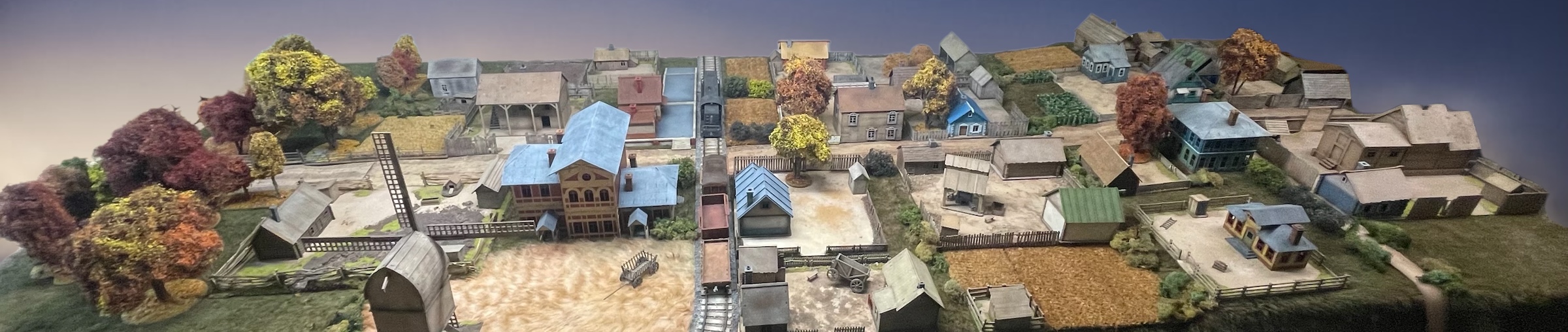
The Soviet Village-Scenario 5 Part 1

 Operation Barbarossa would fail. Its failure would have devastating results  for the German war effort  and would allow the Soviet Union to gain its footing.  That was in the future.    In Autumn 1941 the fight for the Southern front was still in the balance.   The Germans continued to push the Soviets back and cause heavy casualties and destruction of many Soviet tanks and other valuable equipment.  Kiev had fallen and Kirponos was dead.  The Soviets knew they had help arriving in troops from the east, and just as importantly from Russia’s mud and winter.    If they could slow the Axis advance, they could stop the German wave.  

So it was that each village would become a place of contention.  Holding out to slow down the German and Hungarian armies would  buy time.  

The last of five fights of the (real world) three month Barbarossa campaign would be a climactic fight over a small Soviet village somewhere near Kiev. 


Notes
The last fight would be for possession of a Soviet village.  Each side would have three Patrol Markers.  These would maneuver until “locked” and exchanged for Jump Off Points (JOP) per Chain of Command rules.  

Once the JOPs were placed, a line would be drawn connecting the JOPs  to designate which buildings each side would control at the start of the fight. (See below for how it turned out.)


Any buildings that fell behind the front line of the respective armies’ line was controlled by that army, with the additional caveat that in situations in which there is a fenced in “yard” all buildings in that yard count as being controlled by the side whose line crosses the yard.  Due to an uneven distribution of buildings, the church, large Railroad building and blue house count as two buildings each. 


When the battle started the Axis forces controlled all but the blue building on their side of the road for 15 points while the Soviets controlled all but the yard on their far left for 14 points.  

The conditions for control and ultimate victory were as follows:

1. A yard or yardless building is controlled by the side that last gained control whether they have models present or not.  

2. For control to change, the enemy must have at least one model in the yard while no models from the previous controlling force has any models in the yard.  This also applies to yardless buildings.  It is not enough to take a building  in a yard to gain control, but the controlling force must be driven out of all buildings in the yard for control to change.   

3. Every time control changes, the value of the yard or yardless building is added to an ongoing count.  When this count reaches 50, the scenario ends and whoever holds more points worth of buildings at that time wins.  A single yard or yardless building could change hands several times.  Each time, the value is added to the ongoing count.  


The Fight is On. 

The early maneuvering in the battle for the small village was cautious as the two sides moved up to the road to gain possession of those few building that didn’t fall within friendly lines.  The exception was a sortie by a Soviet rifle squad that crossed the road and hurdled a rickety fence to take a muddy farm on the Soviet far right.  


Axis forces were not present in the yard, so this was an immediate change in control.  First blood!

Soviets:19.  Axis 15    Ongoing Count 2

The Soviets didn’t stay long.   The spindly fence provided little cover and a Nimrod Self Propelled Gun arrived and promptly sent the Soviets scampering back across the road, dragging a wounded Serzhant with them. 


Axis forces were not yet able to re-enter the farmyard so the Soviets retained control for now.  

All along the road bisecting the town, small arms fire erupted as squads of infantry ducked behind fences and smashed the glass out of building windows to take up the fight.  


The distances were short and the fire was intense  Reinforcements picked their way through narrow spaces between fences and buildings to bring up ammo and fresh bodies.  


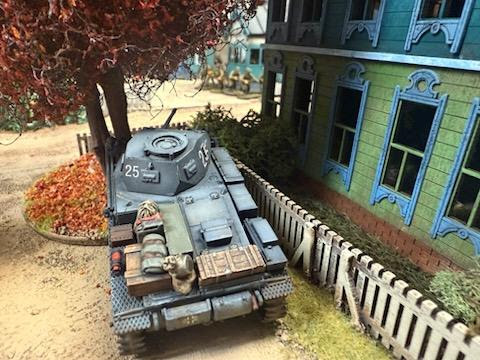
Two Panzer II tanks rolled up behind the Axis line to give support at the same time a T26 and Ba10 did the same for the Soviets. 


The Soviets were taking advantage of a thickly walled Party building across the road from the muddy farm  where they set up a Maxim machine gun.  The gun blasted away at some Hungarians on the ground floor of the large Railroad building. 

All along the front the two sides were engaged. 


Near the muddy farm, the BA-10 avenged the wounded infantry squad leader by firing its 45mm gun at the Nimrod.  A shell pierced the front of the thin skinned Hungarian SPAA and killed the driver.  A nearby Panzer IIB retaliated and forced the BA-10 to reverse undamaged but shaken.   

Near the churchyard, a new threat entered the villlage.  A Panzer 4F rolled up a narrow side street to add its fire.  It had an immediate effect.   An HE shell from its main gun struck home (literally someone’s home) and hit with so much force that the building it targeted caught fire and faced collapse.  (In COC a roll of  three sixes to hit with an HE shell starts to bring down a building.  Four sixes and it immediately collapses.). The Soviet infantry inside, already battered by small anrms  and Autocannon fire, were  now in a bad way. 


The opening phase of the fight was ending and the battle was intensifying.  

Soviets 19.       Axis 15.     Ongoing Count 2


Friday, January 10, 2025

Into Darkness-Scenario 4 Part 3- End Among the Trees

 The battle in deep forest on the Southern front was coming to its conclusion. The German and Hungarian troops had smashed in the Soviet right flank and had swept up supplies and equipment.  All was not lost for the Soviets, as they still had a chance to save an even greater amount of war material than had been captured.   The Soviet pocket was shrinking, and time was running out. 


Game Note: Heading into the final stage of the fight, the Axis forces has seized one Material token.  Two more remained on the board and both were inside the remaining pocket of Soviet resistance.   The two tokens were moving back, but slowly.


The Soviets were giving a good show of resistance, but cracks were forming. They had lost the railroad bridge and a German rifle squad had crossed a rocky ford in the right rear of the Soviet line. The Soviets were down to one deployment Jump Off Point, the other two being captured.  Their morale was also dropping.  

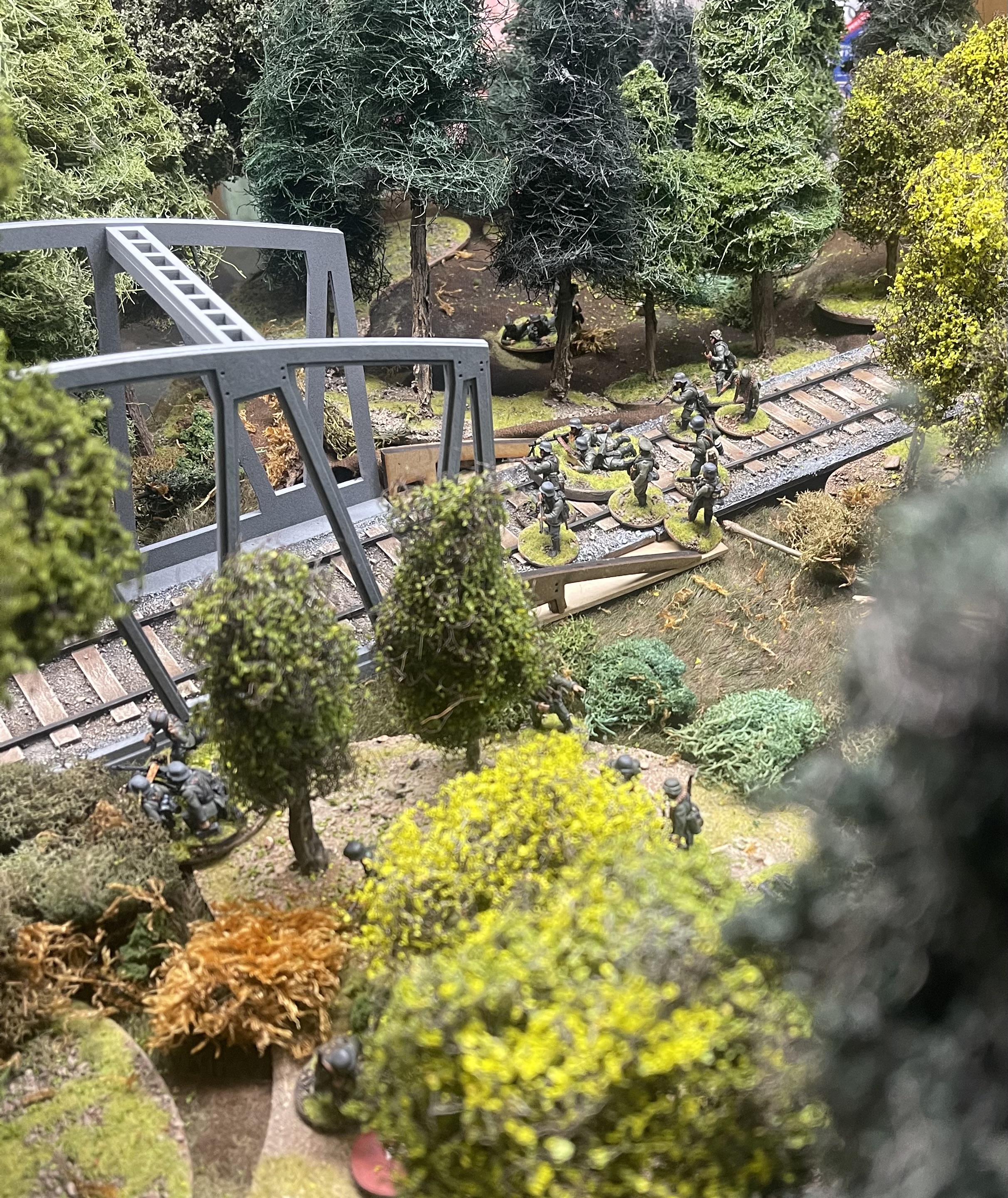
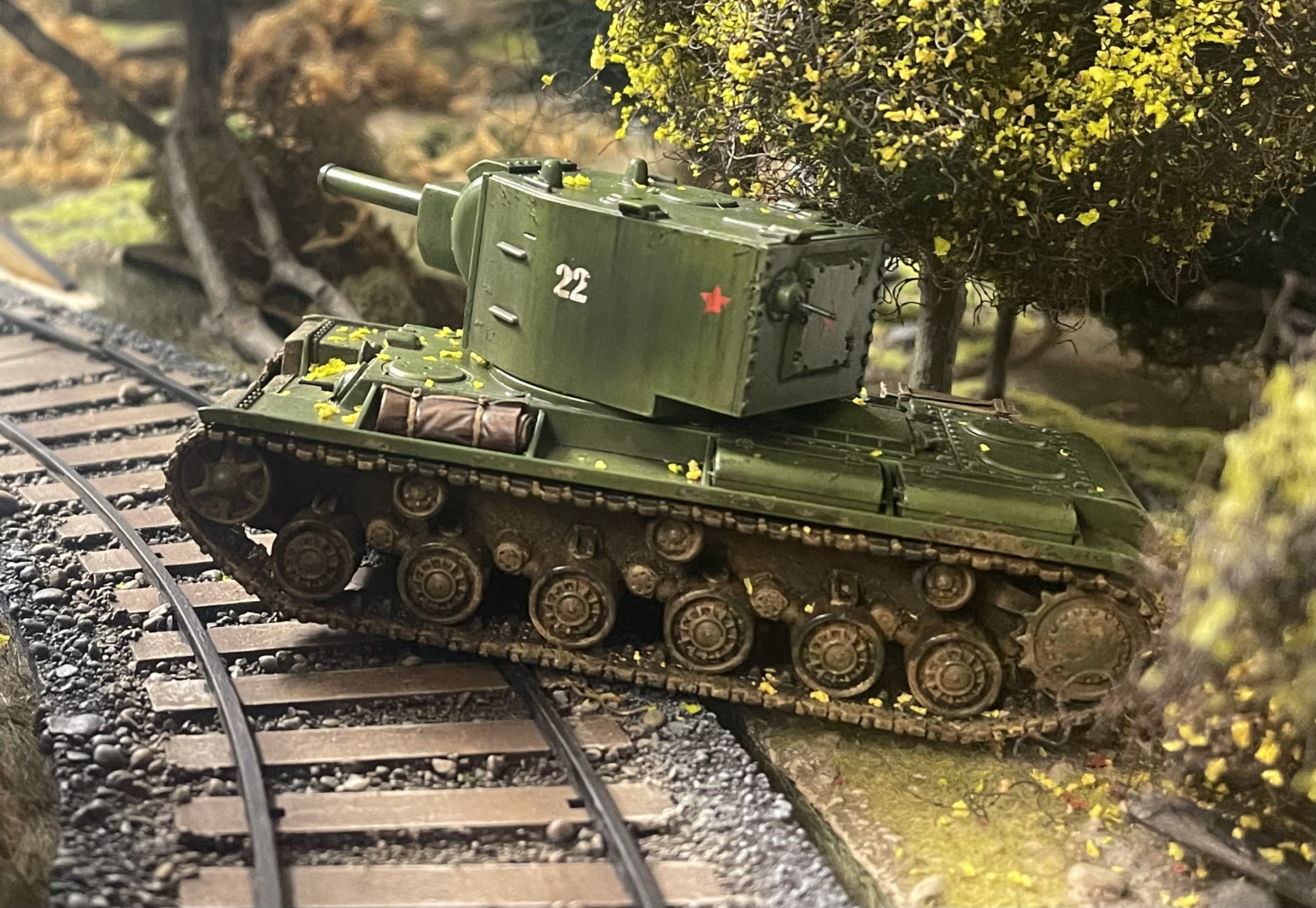
Near the railroad bridge where fierce hand to hand combat had resulted in the taking of the first Material Token by the Germans, the Soviets shored up the line by deploying an additional rifle squad.   Along with the ever-present KV2, two Soviet rifle squads poured murderous fire into the Germans, and checked their advance. A German Fedlwebel and Obergefreiter were wounded, and another Obergefreiter was killed. One of the German squads was pinned down and the other two, weakened by their recent assault could make no headway. 

Holding 

The roaming German rifle squad that had recently crossed the river at a ford, had flanked this end of the line and pushed deeper into the Soviet right rear.  With a show of Initiative that German Squad leaders were known for, the Obergefreiter “volunteered” two men to form a team, load up with explosives and stalk the KV2 that was blasting the Germans on the bridge. 


The two men creeped forward, played a quick game of Rock, Paper, Certain Death, and chose one of them to race at the tank.   With a spirited yell, the chosen brave Lancer ran up to the rear of the beast and lobbed the explosives on to the deck, just behind the turret.  Turning away, the lad then sprinted for a nice solid thing to hide behind and heard a satisfying “boom” as the bombs found their mark.  The trooper, now back in cover, peeked over a log at his handy work  only to see the KV unharmed and unperturbed.    The damn thing was ubiquitous and impervious.  

The fight near the bridge was now a stalemate, but it forced the Soviets to divert troops that were needed elsewhere.   

The Hungarians, who are usually aggressive during these fights, now did what they always do: they died in droves.   This time it led to results.

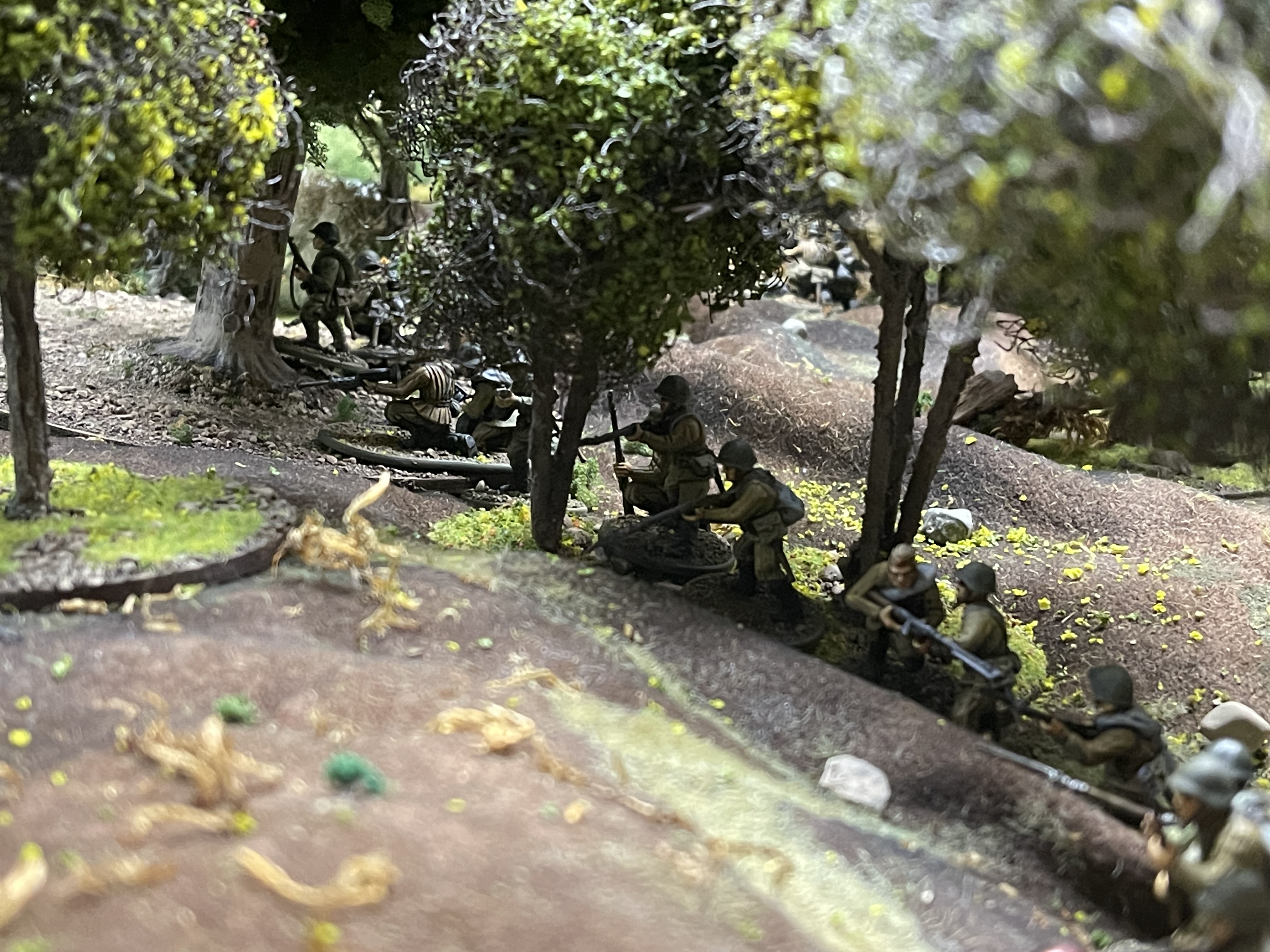
Two Soviet rifle squads that were the center-left anchor in the woods to the left of the open bowl had been trading fire with the advancing Hungarians for most of the day.  Casualties were increasing and one of the squads was without a leader, who was killed early on, and down to a squad machine gun team and single rifleman.   The squad to its right was more intact but taking shock and losing effectiveness.  Worse, the Hungarians were reinforced by another squad, increasing their numbers to thirty-some troops in three (two and half with casualties) squads who were now pressuring the Soviets. 


It was time for the final push.   One of the Hungarian squads volleyed into the tired Russians, while the other two charged.    The resulting hand to hand combat wiped the Soviets to a man.  The Hungarians had driven them out, but themselves sustained heavy losses including a wounded Junior and Senior leader.


The Soviet center-left was gone and they had nothing behind in reserves.   The Hungarians were weakened, but couldn’t be stopped.   They pushed into the retreating supply convoy and captured it with gusto.   The Axis had won the day  


Aftermath and Analysis

The German and Hungarian victory was substantial.   They had captured a majority of the supplies and the Soviets hadn’t rescued any out of the forest.  The Soviets were handicapped by having two Jump Off Points on the opposite side of the river, and only one on the same side as all three Material Tokens.  The grouping of the Material Tokens did allow for a more compact defensive perimeter, but two things happened.   

First, the fickle dice. Significantly more double and even triple phases came up for the Germans than the Soviets. This allowed the Germans to blitz the Soviet right, taking two Jump Off Points in the process and hitting the Soviets from the front and side simultaneously.   This allowed for the capture of the first Material Token.  

Secondly, the Soviets failed to do anything to stop this blitz.   They did not deploy from the Jump Off Point nearest the river. (They had made a strategic decision-probably a sound one-to ignore the far right JOP as a waste of resources to defend.) They didn’t try to block either the Railroad bridge or the ford.  A single squad (or giant tank) at either location would have bottlenecked the German attack on that flank.  The Soviets were unprepared for the rapidity of the German attack. 

The Axis forces realized early on that the open bowl in the middle was a bad job.  Once they decided to go around, they were able to catch the Soviets at the edges where there was less of a defense. 


The fifth and final fight was now to come. 


Friday, January 3, 2025

Into Darkness-Scenario 4 Part 2-The Rapid Advance

 After the initial tentative push, the Axis forces now increased the pressure.   The hottest fighting continued in the center of the forest in an open depression in the ground, now gaining the sobriquet “The Bloody Bowl.”


The Russians were putting up stiff resistance and German casualties were mounting.  If the Axis forces were going to capture and wreck the withdrawing Soviet army, they were not going to do it here.  

Thus it was that the Axis refined the plan and decided on a left flank wheel that would attempt to cross the river and try to cave in the Soviet right.  


While the Soviets were trying to hold the middle, and had deployed a majority of their forces there, the right flank was less heavily guarded as all three Material Tokens were to the left of the river.  The Germans used this to their advantage.   Quickly, a pair of infantry squads with support from a tripod mounted MG 34 and a 38T grabbed the two Jump Off Points on the near side of the river.  The rapidity of the advance surprised the Russians and left them with only one Jump Off Point on the field and no presence to the right of the river.

The Rapid Advance. 

This wasn’t necessarily a doomed ending for the Reds as all three Material Tokens were opposite the river and still protected but it shrank the defensive pocket and hurt morale due to the lost JOPs.

On the opposite side, the Hungarians had identified the marker in their front as a Material Token and made a push for it, only to run into the Old Beast.   Almost obsolete, but with so many turrets, they were superfluous, the T-28 tank was a lumbering anachronism. Now, it lumbered through the woods and straight at the Huns. 

The Hungarians were shelled.   Adding injury to injury, a nearby Soviet infantry squad poured fire into the hapless Huns.  They couldn’t stay where they were, so the Hungarians ran by the tank and into heavy brush, while trying to draw straws to assemble the tank hunting team.  Before they could charge their satchels, the mighty T-28 pivoted and amputated the Hungarian squad leader’s arm with a tank shell.  The squad was now pinned and could only cower.

Think it sees us?

The Soviets successfully withdrew the  Material Token that was under the tank and pulled it 6” closer to salvation at the friendly table edge. 

Elsewhere, the Hungarians and Soviets battled to a stalemate around a second Material Token. Using the only Jump Off Point left, the Soviets deployed two (!) Maxim Machine Guns to shore up the woods directly to the left of the Bloody Bowl.


The Hungarians tried to match this firepower and advance on the Soviets, but it was not going to be easy.


They’re in where?

Back in the middle, the KV2 sent a shell through the woods and knocked out a 38T that forgot to duck. The formerly Czech formerly tank spewed oily smoke, which darkened the already dark forest further.


It was then that things started to heat up.  The Germans on the Axis left had made their swing.   Two squads rushed across the rail bridge while a third skirted the left of the bowl.  

Game Note: in COC there is the possibility of seizing the initiative by activating in successive phases by rolling sixes.   This could allow a player to act twice in a row, or in rare instances, three times.   Tonight, one particular German player seized the hell out of the initiative , allowing the Germans to race across the (unguarded) rail bridge.  

The force with which the three German Squads slammed into a single Soviet squad, erased the hapless Soviet squad from the field.  The KV2, which was very close by was effectively distracted by a second 38T that has snuck across the river to the rear of the Soviet tank.  


The 38T missed the shot and paid dearly when a T-26 arrived on the field behind the Czech tank and one-shotted it by firing a shell through the back of its turret. 


The price paid was worth it.   The assault by the Germans had gained the first Material Token.  One more and the day would be theirs.   

As it stood, the Soviets were being squeezed but still held. 


Could the Soviets hold and get off the field intact?

The Hungarians in the timber 


Tuesday, December 24, 2024

Into Darkness-Scenario 4 Part 1-The Advance Into the Woods


 September 1941 was a disaster for the Soviet Southern front.   Kiev had fallen and General Kirponos was dead. 600,000 Soviet prisoners entered German captivity.  Kharkov was the next major target for Axis forces in the south, but there were small Soviet detachments to deal with as well. German and Hungarian units were detached to find and destroy the sometimes resisting and sometimes fleeing Soviet troops. 

The Soviets made use of the primordial forests that dotted the country. Routed soldiers would flee and rejoin units or establish partisan bands that would cause continuous headaches for the German and Hungarian troops.  Companies of men and supports were needed to flush out the defenders hiding amongst the trees.  This task is represented by the fourth scenario of the Barbarossa campaign.  

Notes: This battle could be very short or could play for several weeks.  Once again, several house rules, mostly untested would be implemented.  

The board is a forest with small clearings throughout.  A small river cuts down the middle of the board. .  Six tokens will be “placed” on the board.  Three represent Soviet Jump Off Points and three represent equipment, wounded and other material that the Soviets are trying to get off their table edge. Which is which is not known until later  


Because we are immature and easily entertained, the tokens were to be  literally tossed onto the board in alternating turns by Axis and Soviet players with the tokens having to land in the area of play.  This was scrapped after tokens hit the floor and there were possibly eye injuries from bad throws.  We are not athletes in the traditional sense.

It ended up like this 


The Material Tokens

Soviet Victory can only be achieved by the Soviets getting at least two of the three Material tokens off their side of the board or by breaking the Force Morale of the Axis side  Material tokens can only be moved 6” at a time by spending a Chain of Command die. Once the Material token is off the Soviet Retreat to Safety table edge it has escaped  

Axis Victory can only be achieved by the Axis capturing at least two Material Tokens.  This is done in the same way as capturing a Jump Off Point by having a friendly model within 4” and ending a turn.

Additionally, the Axis may attempt to block the movement of the Material token by spending a Chain of Command die and rolling a 5 or 6 on a D6.  Only one attempt can be made per Material token movement action. If successful, the Soviet side still spends rhe Chain of Command die to move the Material token but the token doesn’t move.

With the tokens now placed (not thrown) the Soviets randomly roll to determine which three tokens are the Jump Off Points  

The rolls set up as follows:


This set up created a situation in which the Soviet left flank was uncovered and the right flank was heavy with Jump Off Points.  This was not immediately clear to the Axis side, but would be as soon as the Soviets began deploying.

The Axis forces acted first, and not knowing where the Material Tokens were located advanced in a balanced line with the Hungarians taking the right, but also prematurely deploying a light Anti-Tank gun with a field of fire down the railroad line and across the rail bridge. The Germans deployed in the center facing an open bowl and to the left of a small river that meandered through the center of the board.

So peaceful

Hungarians advance 


The Soviets quickly deployed on the far right and across from the Germans facing the open bowl in the center.  This would be where the day’s first action would be focused.   A Soviet rifle squad that had been hiding amongst the trees opened up on the Lancers and drew first blood.  The Germans responded in kind and deployed a medium machine gun and 38T Czech tank.  Two more Soviet Infantry squads deployed in succession.  The fire was hot.   The initial German Squad was bloodied and pulled back to be replaced by a second Squad.  The Soviets were using their cover well and sustained only light casualties, but the tripod mounted MG 34 was and Czech tank was going to be a problem. 

The Battle of the Bowl..The Blood Bowl?

There was a solution to such a problem.   Just as the sun will always climb the morning sky, the dreaded KV2 will come rumbling through the woods.

Game Note: Again.. the KV2 was pulled in the random support draw by the Soviet player.   The Soviet pool of tanks includes something like 30 vehicles and AT guns of which two are KV2s.  Each Soviet player, of which there are two in this scenario, draws two assets.  That’s a 4 in 30 chance.  

 And so it was that the KV2 rolled across the railroad tracks and first pivoted its monstrous gun to blast the meek and ineffective Hungarian AT Gun.   Leaves dropped onto the beast as the forest shook.  Then the tank rolled forward and blasted the Germans facing the bowl.    Inspired, Soviet rifles and Machine guns joined in the fire, and drove off the Machine Gun crew.  Dead and running crew left an unmanned gun quiet and useless in the deep woods.


Elsewhere the Hungarians raced for the exposed Material token that represented valuable ammo, supplies and wounded on the far Soviet left.  Crossing heavy brush and downed trees, the Hungarians advanced.  The desperate Soviets moved left to counter and a brisk and deadly firefight began.


The Soviets were able to withdraw the supplies back by using a COC die.   Six inches closer to safety!


On the Axis far left, a pair of cautious German infantry squads with Machine gun support advanced slowly toward a single Soviet squad that acted as bait to draw the Germans away from the objectives.


A Stoic Soviet leader stands and watches his charges stoically 

The opening of the forest battle had commenced.   Could the Axis forces push forward and grab the valuable Soviet supplies, or would the Soviets hold them off and make it away to safety?  

To be continued  


Friday, December 13, 2024

Counterattack Near Uman-Scenario 3 Part 5-The Defense

 The Soviet counter attack was nearing its conclusion.  They had pushed in the Axis right flank and driven the Hungarians from the small farm, causing significant casualties.  In the center and Soviet right the Russians had found stiff resistance and were progressing slowly. 


The Single remaining German infantry squad on the right decided not to stick around and fled through thickets and onto the road that exited the smaller bridge.  The Axis wisely used a COC die to move the Jump Off Point toward the center, thus avoiding its capture.  A reserve Hungarian squad then emerged from hiding at the new JOP location and battled with the Soviets who were in pursuit from the farm.  They also deployed a Medium machine gun to cover the center of the line against the single Soviet squad that continued to lurk in between some buildings.


The Panzer 3 pivoted to engage the T-26.  A blast from its main gun banged off the Soviet tank killing the driver as shell shrapnel breached the vision slit.   The remaining Soviet crew had enough and bailed from the tank, and fled back across the bridge.  


On the opposite flank rhe Russians were taking heavy losses on the large bridge.  The hero of the moment was a medic who had crossed the bridge with the assaulting infantry.  He bandaged both the Junior and Senior leader and kept the squad from disintegrating.

The medic has a gun.  Why does the medic have a gun?

The Germans continued to pour fire into Soviet fighters  who clung to the near bank in the walled courtyard in the middle of the line.  The fire was too much and the Soviets routed.  The attack in that part of the line  was effectively over. 

A Hungarian sniper used the opportunity to climb to the third story of burnt out committee building and send a Soviet mortar squad across the river fleeing to cover. 


Back on the Russian left, the Soviets were obsessing over the Panzer.  A 45mm Anti Tank gun that had been quietly deployed in the woods next to the large bridge made its presence known by bouncing a shell harmlessly off the front armor of the Panzer.  


The Panzer CO decided he had enough and drove towards the middle of the line along the road perpendicular to the small bridge road.  Thinking fast, the 45mm gun crew wheeled their gun and pushed it through the wood, allowing them to catch the German tank in the flank.  They slammed a shell into the breach and fired.  A hit!  The Panzer driver was killed and the tank ground to a halt, while the Panzer crew pulled the dead driver from his seat and tried to replace him.  A Soviet with a satchel charge ran up to the tank and let fly with the explosive but was unsuccessful in doing any further damage. 

Several German squads decided it was time to clear out the sneaky Soviet squad (sounds like an Eastern European Scooby Doo gang) that had been lurking in the middle.  The Soviets pulled back to safer ground and fended off an ill coordinated German charge, causing a high level of carnage. 


As sure as the sun rises in the Russian east, whenever rhe KV2 (against odds) shows up, an 88mm gun shows up (also against odds) as well.  So it was that a short duel was had between these two forces of nature.  It didn’t live up to the hype.  The 88 missed and the KV caused no casualties to the gun crew in the brief scuffle. 


This turned out to be the last act.  

The Results

The original condition for victory was the elimination of the Force Morale of the opponent.  Five weeks of ( real) game time left the Germans with 11 and the Soviets with 13.  This does not tell the story.  The Soviet attack on the right and middle was over.  The Germans had complete control of the defensively strong stone and steel buildings at the city’s edge. The Soviets held the farm but would have to fight across a narrow slice of land and into the city. Any further Soviet support would have to either come from the lone Jump Off Point to make it across the bridge near the farm, or by crossing the big bridge ( a death trap); or another launch of rafts (a bigger death trap in the light of day.)

The Soviets just didn’t have the immediately available support to break into the city.  Their casualties would have been enormous and they would be attacking without sufficient command support, as a good deal of  squad and higher leaders who made it across the river were dead or wounded.  

In the end the Soviet attack was not successful.  The German army would continue their advance.  They would now be ordered into a very nasty few acres of  woods where they would have to flush out the regrouping Soviet army…

Chapter One:The Patrol

“  The Incident on Saint Isadore Caenum began at the port in Hennelsburg  with a plan to infiltrate Warmaster Hollenlarm’s advanced agents o...